

For Canadian immigration, supporting documents that are not in English or French generally need an English or French translation. The exact certification, affidavit and source-document requirements depend on the application program and its document instructions, so applicants should follow the relevant IRCC checklist rather than relying on one universal rule.
Translation can look like a small administrative task, but incomplete or inconsistent supporting documents can lead to requests for further evidence or other processing problems. Immigration, Refugees and Citizenship Canada (IRCC) publishes translation instructions for individual programs, and those instructions should be checked before a document is submitted.
At IRCC Translation, we help applicants prepare translations of birth certificates, marriage certificates, police certificates, academic records, civil-status documents, court documents and financial records for Canadian immigration applications.
Need a certified translation for your Canadian immigration application? Upload your file today and receive a clear quote before work begins.
Certified Translation for Canadian Immigration: Simple Definition
IRCC does not use one identical translation rule for every application. For Express Entry, IRCC defines a certified translator as a member in good standing of a professional translation association in Canada or abroad, with certification confirmed by a seal or stamp showing the translator’s membership number. Other IRCC programs, including citizenship routes, may also permit an uncertified translator who is fluent in both languages when the required affidavit is supplied.
For Canadian immigration purposes, this usually means the translation must:
- Be in English or French
- Match the original document accurately
- Include all visible text, stamps, seals, signatures and handwritten notes
- Be completed by a translator permitted by the instructions for the specific IRCC program
- Include translator certification or an affidavit where required
- Be submitted with the original document or certified copy, depending on the application instructions
In plain English, IRCC does not only want to understand the document. It needs to trust that the translation is a faithful version of the original.
Why Canadian Immigration Applications Need Certified Translations
IRCC officers review documents from applicants all over the world. These documents may be written in Arabic, Spanish, French, Mandarin, Urdu, Hindi, Russian, Turkish, Portuguese, Ukrainian, Farsi, Korean, Japanese, German, Italian or hundreds of other languages.
A certified translation allows the officer to understand:
- Who the document belongs to
- What the document proves
- Whether the information matches the rest of the application
- Whether dates, names and places are consistent
- Whether the document supports the applicant’s eligibility
A poor translation can create problems even when the original document is genuine. Small mistakes in names, dates, marital status, degree titles or police record wording can cause confusion, extra document requests or delays.
When Do You Need a Certified Translation for Canadian Immigration?
You usually need a certified translation when a document required for your Canadian immigration application is not in English or French.
Common application types include:
- Permanent residence applications
- Express Entry
- Provincial Nominee Program applications
- Spousal sponsorship
- Family sponsorship
- Study permit applications
- Work permit applications
- Visitor visa applications
- Citizenship applications
- Refugee and humanitarian applications
- Passport and travel document applications
- Police certificate submissions
- Replacement immigration document requests
If the original document is already in English or French, you normally do not need a translation. If part of the document is in another language, that part may still need to be translated.
Documents That Often Need Immigration Document Translation
Many applicants only think about birth certificates, but immigration document translation can cover a wide range of records.
Personal and Civil Status Documents
- Birth certificates
- Marriage certificates
- Divorce certificates
- Death certificates
- Adoption documents
- Name change certificates
- Family registers
- Household registration records
- National identity documents
Education and Professional Documents
- Degree certificates
- Diplomas
- Academic transcripts
- School records
- Professional licences
- Training certificates
- Apprenticeship records
Legal and Police Documents
- Police clearance certificates
- Court judgments
- Custody documents
- Affidavits
- Legal declarations
- Criminal record checks
- Military records
Financial and Employment Documents
- Bank statements
- Tax documents
- Payslips
- Employment letters
- Business registration documents
- Company ownership records
Medical and Other Supporting Records
- Medical reports
- Vaccination records
- Disability documents
- Travel history evidence
- Letters from institutions or public authorities
Unsure whether your document needs translating? Send it to IRCC Translation for a quick review and quote.
Certified Translator, Translator Certification and Affidavit: What Is the Difference?
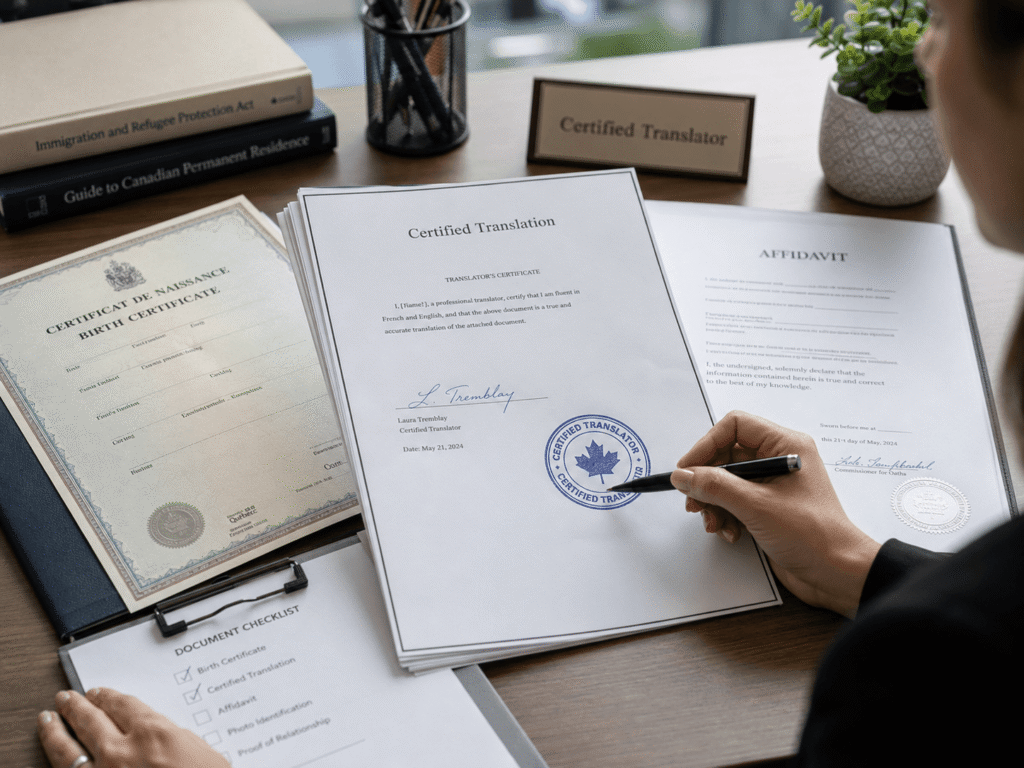
The most confusing part of certified translation for Canadian immigration is understanding the difference between a certified translator, translator certification and an affidavit.
Certified Translator
A certified translator is a translator who holds recognised professional status through a relevant translation association or body. In Canada, this usually means a translator who is a member in good standing of a provincial or territorial organisation for translators and interpreters.
A certified translator may use an official stamp, seal or certification statement to confirm the translation.
Translator Certification
Translator certification is the translator’s formal confirmation that the translated document is accurate and complete. It may include:
- Translator’s name
- Translator’s signature
- Certification statement
- Stamp or seal
- Membership or registration number
- Date of certification
- Contact details
- Source and target language pair
This is what turns a normal translation into an official translation Canada applicants can submit with confidence.
Affidavit
An affidavit is a sworn statement confirming that the translation is true and accurate. It is usually sworn before an authorised person, such as a notary public or commissioner of oaths.
Affidavit requirements depend on the application. For example, current Express Entry instructions provide an affidavit route when a translation cannot be completed by a certified translator, while citizenship guidance permits an uncertified fluent translator when the required affidavit is provided. Always check the instructions for the specific program before submission.
Certified Translation vs Notarised Translation vs Sworn Translation
Applicants often use these terms interchangeably, but they are not the same.
| Type | What It Means | When It May Be Needed |
|---|---|---|
| Certified translation | Translation completed with a signed certification statement, stamp or seal | Common for IRCC applications |
| Notarised translation | Translation or translator declaration witnessed by a notary | Sometimes needed for affidavits or additional legal assurance |
| Sworn translation | Translation completed by a sworn translator under a country’s legal system | Common in some countries outside Canada |
| Certified true copy | A copy of the original document certified as a true copy by an authorised person | May be required when submitting copies rather than originals |
The safest approach is to check the exact document checklist for your application type and prepare the translation according to those instructions.

What Must an IRCC Translation Include?
A strong certified translation for Canadian immigration should include more than just translated text.
It should normally contain:
- Complete translation of all visible text
This includes printed text, handwritten notes, marginal notes, stamps, seals, signatures and official wording. - Accurate spelling of names
Names should match passports, identity documents and application forms wherever possible. - Clear dates
Dates should be translated carefully, especially where the source document uses a different date format or calendar system. - Translator certification statement
The translator should confirm that the translation is accurate and complete. - Translator details
The translation should identify who completed or certified the work. - Stamp, seal or signature
Where applicable, the translation should include the translator’s official stamp, seal or signature. - Original or certified copy reference
The translation should clearly relate to the source document used. - Affidavit if required
If the translator is not a Canadian certified translator or the application instructions require an affidavit, this should be prepared correctly.
Example: How One Small Translation Issue Can Delay an Application
Imagine a birth certificate where the applicant’s name appears in a non-Latin script. The passport shows the name as “Mohammed Al Hassan”, but the translation uses “Muhammad Alhasan”. The date of birth is also written as 04/07/1995, but the source country uses day-month-year format and the Canadian form is read as month-day-year.
None of these issues necessarily mean the document is false. But they create uncertainty.
A careful immigration translator would:
- Check name spelling against the passport
- Preserve the original meaning
- Add translator notes where needed
- Keep date formats clear and unambiguous
- Translate every stamp and official remark
- Avoid inventing information not shown in the source
This is why certified translation is not just language conversion. It is document handling for an official immigration process.
Who Can and Cannot Translate IRCC Documents?
Translator restrictions vary by program. Applicants should not translate their own documents, and current IRCC guidance commonly restricts translations by family members. Express Entry instructions also state that an applicant’s representative or consultant cannot translate the documents. Check the exact application guide because the permitted translator and affidavit route can differ between programs.
Avoid using:
- Yourself
- Your spouse or partner
- Parents or guardians
- Children
- Siblings
- Grandparents
- Aunts, uncles, nieces, nephews or cousins
- An immigration representative or consultant where the relevant IRCC instructions prohibit it
The safest approach is to use a translator who meets the rules for your application and to include any certification, affidavit and source-document material that the relevant IRCC instructions require.
Can You Use Google Translate for IRCC Documents?
No. Machine translation is not suitable for Canadian immigration documents.
Google Translate, AI translation tools and automatic document translation software can be useful for understanding the general meaning of a text, but they cannot provide professional certification, accountability or sworn confirmation of accuracy.
For immigration purposes, a translation should be completed or reviewed by a qualified human translator who understands official documents, terminology, certification rules and the importance of consistency.
What Happens If a Translation Is Wrong or Incomplete?
An incorrect or incomplete translation can lead to:
- Application delays
- Requests for additional documents
- Returned applications
- Confusion about identity or eligibility
- Problems matching information across forms
- Extra translation and notary costs
- Missed deadlines
The risk is higher with documents that contain legal, civil registry, police, court, academic or financial terminology.
This is why IRCC Translation checks names, dates, seals, stamps and formatting carefully before certification.
How to Prepare Documents for Certified Translation
Before requesting your translation, prepare your documents properly.
Step 1: Scan the Document Clearly
Use a clear colour scan or high-quality photo. Make sure all corners are visible and no text is cut off.
Step 2: Include Both Sides
If the back page contains stamps, signatures, conditions, serial numbers or notes, include it.
Step 3: Send Any Passport Name Spelling
If your document is in another script, send the exact spelling used on your passport or Canadian application.
Step 4: Confirm the Application Type
Tell the translator whether the translation is for Express Entry, study permit, work permit, family sponsorship, citizenship or another IRCC route.
Step 5: Ask Whether an Affidavit Is Needed
The translator can advise based on the document and application route, but the final requirement depends on IRCC’s document checklist and instructions.
Step 6: Review the Draft
Check names, dates and document numbers before final certification. Once certified, changes may require reissuing the document.
Start your project with IRCC Translation today. Upload your document and receive a clear quote with the expected turnaround time.
Certified Translation Checklist for Canadian Immigration
Before submitting your translated document, check the following:
- The translation is in English or French
- The translation is complete
- All stamps and seals are translated
- Names match your passport or official documents
- Dates are clear and consistent
- The translator has included certification details
- The translator’s stamp, seal or signature is visible
- An affidavit is included if required
- The original document or certified copy is included where required
- The file is clear and readable before upload
How Much Does Certified Translation for Canadian Immigration Cost?
The cost depends on the language, document type, word count, formatting and whether certification, affidavit or notarisation is required.
Short certificates are usually priced per page, while longer records such as bank statements, academic transcripts, court documents or medical records may be priced by word count, page count or complexity.
Factors that affect the price include:
- Language pair
- Urgency
- Document length
- Handwritten text
- Poor scan quality
- Number of stamps or seals
- Formatting requirements
- Affidavit or notary requirements
- Hard copy delivery
IRCC Translation provides a fixed quote before starting, so there are no surprises after you submit your documents.
How Long Does Certified Translation Take?
Simple certificates can often be completed quickly, while longer or more complex documents may take more time.
Turnaround depends on:
- Number of pages
- Language pair
- Document clarity
- Certification requirements
- Whether an affidavit is needed
- Whether a hard copy is required
If you have an immigration deadline, send the document as early as possible. A rushed translation increases the risk of mistakes, especially where names, dates and stamps must be checked carefully.
Why Applicants Choose IRCC Translation
IRCC Translation supports individuals, families, students, workers and professionals preparing Canadian immigration applications.
Our service is built around three priorities:
Accuracy
Every translation is handled carefully, with attention to names, dates, official terminology, seals, stamps and document layout.
Compliance
We prepare certified translations for Canadian immigration use and advise when an affidavit, notary support or certified copy may be needed.
Clarity
You receive a clear quote, practical guidance and a professionally prepared translation suitable for your application file.
Ready to translate your documents for Canadian immigration? Upload your file now and get a quote.
Common Mistakes to Avoid
Translating Only the Main Text
Stamps, seals, handwritten notes, signatures and marginal comments can all matter. If they appear on the original, they should be addressed in the translation.
Using a Family Member
Even if a family member is fluent, this can create a conflict of interest and may not be accepted.
Ignoring Name Variations
Name spelling must be handled carefully, especially where documents use different alphabets or naming conventions.
Submitting a Blurry Scan
If the translator cannot read the source clearly, the final translation may contain uncertainty notes.
Forgetting the Affidavit
Where an affidavit is required, the translation alone may not be enough.
Waiting Until the Deadline
Certification, review, notarisation or courier delivery can take extra time.
Practical Example: Birth Certificate Translation for Canadian Immigration
A birth certificate translation for Canadian immigration should normally include:
- Full name of the child
- Date and place of birth
- Parents’ names
- Registration number
- Issuing authority
- Date of issue
- All stamps and seals
- Any handwritten notes or amendments
- Translator certification statement
- Translator stamp, signature or seal
If the certificate includes a stamp in another language, that stamp should be translated too. If part of the stamp is unclear, the translator should mark it appropriately rather than guessing.
Practical Example: Police Certificate Translation for IRCC
A police certificate translation must be especially precise because it relates to admissibility.
The translation should clearly show:
- Applicant’s full name
- Date of birth
- Nationality or ID details
- Issuing police authority
- Certificate number
- Result or record status
- Dates of issue and validity
- Official stamps and seals
- Any remarks, cautions or record notes
A mistranslated police certificate can cause serious confusion, so this type of document should always be handled by an experienced immigration document translator.
Practical Example: Academic Transcript Translation
Academic documents often contain grading systems, course titles, institutional stamps and academic terminology.
A good academic translation should:
- Keep course names clear
- Preserve grades and credits accurately
- Translate institutional titles properly
- Avoid converting grades unless officially required
- Keep tables readable
- Translate stamps, seals and notes
- Maintain consistency with degree certificates
This is especially important for study permits, credential assessments, professional licensing or employment-related immigration evidence.
Official IRCC Translation Requirements: Current Sources
Last checked: 21 September 2026. Translation requirements are application-specific. The safest approach is to use the instructions and document checklist for the exact immigration, citizenship or passport application you are making.
| Application or guidance | What the current official guidance says |
|---|---|
| Express Entry permanent residence | A non-English/French supporting document needs an English or French translation. IRCC provides a certified-translator route and, when a certified translator cannot complete the translation, an affidavit route. The source document or the certified copy used for the translation must also be provided as instructed. |
| Adult Canadian citizenship | Citizenship guidance permits a certified translator or an uncertified translator who is fluent in both languages. An uncertified translator must provide the required affidavit and cannot be the applicant or one of the listed family members. |
| Canadian passport applications | Passport guidance has its own rules for certified professional, non-certified professional and qualifying third-party translators, so passport requirements should not be assumed to be identical to immigration-program requirements. |
| IRCC Help Centre: language of supporting documents | IRCC’s general Help Centre says supporting documents normally need to be in English or French and sets out translation, affidavit and certified-copy requirements unless applicants are told otherwise. |
How to Check Translator Certification in Canada
The Canadian Translators, Terminologists and Interpreters Council (CTTIC) lists its provincial member societies and explains that certification is handled by provincial bodies rather than by CTTIC itself. Public directories such as the ATIO directory in Ontario and the STIBC directory in British Columbia can be used to check professionals listed by those associations. A directory listing should be verified directly with the relevant association when certification status matters to an application.
Related IRCC Document Translation Services
For document-specific requirements and quoting, see our pages for birth certificate translation, marriage certificate translation, police certificate translation, academic transcript translation, degree certificate translation and bank statement translation.
FAQ
What is a certified translation for Canadian immigration?
A certified translation for Canadian immigration is an official English or French translation of a foreign-language document, prepared with a translator certification, stamp, seal or statement confirming that the translation is accurate and complete.
Do all IRCC documents need certified translation?
Only documents that are not in English or French usually need translation. If your document is already fully in English or French, you normally do not need to translate it unless IRCC gives specific instructions.
Does IRCC require an affidavit for every translation?
Not always. An affidavit may be required if the translation is not completed by a Canadian certified translator or if the application instructions request it. Always check the requirements for your specific application type.
Can I translate my own documents for Canadian immigration?
No. You should not translate your own immigration documents. Family members are also generally not accepted, even if they are fluent in both languages.
What documents commonly need immigration document translation?
Common documents include birth certificates, marriage certificates, police certificates, academic transcripts, diplomas, court documents, ID documents, bank statements and employment records.
How do I get an official translation Canada will accept?
Use a professional translation provider that understands Canadian immigration requirements. Send a clear copy of the original document, confirm the application type and ask whether certification, affidavit or notarisation is needed.
Related compliance guide: See certified-translator eligibility for different IRCC programmes and follow the requirements of your own IRCC application.
[…] If the application instructions are unclear, use the current IRCC guide for that program and ask the translator to explain which certification or affidavit route they are providing. For broader context, see our certified translation for Canadian immigration guide. […]